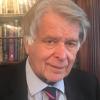
Editors comment
Professor John Studd passed away on the 17th August 2021.
The enormous contribution that he made in the area of women's health and to our understanding of the menopause in particular cannot be overstated. He pioneered the use of HRT, setting up the first specialist menopause clinic in Europe in 1969 - in Birmingham. He also co-founded the National Osteoporosis Society, now the Royal Osteoporosis Society.
Total Health had the honour of working with "The Prof" for over a decade and he will be very badly missed. However, his legacy will endure, and a number of specialist consultant gynaecologists who were trained by him now also contribute to Total Health - please click here for further information.
Founder and Vice-President of the National Osteoporosis Society & Council. Member of the Royal College of Obstetricians and Gynaecologists. Past-President of the Section of Obstetrics and Gynaecology at the Royal Society of Medicine. Chairman of the British Menopause Society 2005-2007.
He was Consultant Gynaecologist in Salisbury, Rhodesia and Consultant and Senior Lecturer at the University of Nottingham and moved to London in 1974 as Consultant Obstetrician and Gynaecologist at King's College Hospital. Prof Studd was later Consultant Gynaecologist at the Chelsea & Westminster Hospital, London and also Professor of Gynaecology at Imperial College. He now runs the London PMS & Menopause Centre.
Prof Studd has a D.Sc. for 25 years of published work on oestrogen therapy in women. He has written more than 500 scientific articles and written or edited more than 25 postgraduate books on gynaecology.
Champion for Women's Health
Prof Studd is internationally recognised as one of the world’s most authoritative and experienced gynaecologists. He has championed the use of hormone implants for women with osteoporosis or with severe depressive or sexual problems after the menopause and as an almost routine route of HRT after hysterectomy.
Prof Studd started the first ever menopause clinic in the county. This hormone treatment for the menopause was so controversial at the time that the clinic was closed down for three months following protests from the BMA. However, the optimism placed in HRT has been confirmed and Prof Studd has continued to work on specific treatments for menopausal symptoms. He pioneered the sequential oestrogen/progestogen treatment and also the continuous combined oestrogen/progestogen non-bleeding treatment. He has championed the use of hormone implants for women with osteoporosis or with severe depressive or sexual problems after the menopause and as an almost routine route of HRT after hysterectomy.
He first described the use of oestrogen patches and oestrogen implants for the treatment of severe PMS, postnatal depression and perimenopausal depression.
He feels strongly that women are not always given the best medical advice around the use of hormones as doctors often do not understand the intricacies of route, dose, combination with testosterone and the varied indications.
He says that he realises that he needs to write a text book for the public. "This is much more challenging, but the following articles for Total Health are an excellent starting point."
His article Top ten reasons to be happy about HRT, first published in Total Health explains the broad range of benefits that HRT started to bring to women. This list keeps getting updated with more benefits - including protection against Alzheimer's disease. In a podcast he summarises some of the challenges he faced, saying:
"... in spite of all the occasional bad news you get about cancer of the breast or strokes or whatever, it really isn't true and there was this very expensive 2002 study of oral oestrogens in America where they chose the wrong drug, the wrong route, the wrong patients, the wrong age, and came to the wrong conclusions and this is a study that cost more than one billion dollars.."
He then goes on to say:
"And the investigators are now going around the world lecturing and apologising for the mistakes they've made and for this big baby-boomer generation in America who have been denied for about ten, twenty years hormone therapy for their symptoms and their long-term health based upon bad data. So all the evidence now is that there are not more heart attacks but fewer heart attacks, there are not more strokes but fewer strokes, and the breast cancer story that keeps popping up is not related to oestrogens because every study that looked at oestrogens alone showed no change or a decrease in breast cancer".
Professor Studd was awarded the Blair Bell Gold Medal of the Royal Society of Medicine (RSM), which is only given every 5 years to the Gynaecologist who has made the biggest lifetime contribution to the specialty.
Editors note
It has been remarkable just how much medical nonsense the good Prof has had to deal with in order to ensure that women (and men) get appropriate care. He has taken on prejudice, enforced closure, the professional bodies, cancer, mega finance and professional jealousy before the sheer weight of evidence finally shows him to be right. Why? because he cares for his patients. His hand-picked team of gynaecologists including Mike, Neale and Beverly are delighted to be able to now build on that legacy.
John has now retired from practice, but continues to write.
See also Consultant Profile